
Developments in Medical Image Processing with Gen-AI

The integration of Generative AI into medical image processing has ushered in a new era of innovation, enhancing diagnostic accuracy, treatment planning, and patient outcomes. This document explores the recent advancements in this field, highlighting the applications, benefits, and challenges associated with the use of Generative AI in medical imaging. By examining the current landscape, we aim to provide insights into how these technologies are transforming healthcare.
Introduction
Medical imaging plays a crucial role in diagnosing and treating various health conditions. Traditional methods, while effective, often face limitations in terms of speed, accuracy, and the ability to analyze complex data. Generative AI, particularly through techniques such as Generative Adversarial Networks (GANs) and Variational Autoencoders (VAEs), has emerged as a powerful tool to address these challenges. These technologies can generate high-quality synthetic images, enhance existing images, and even assist in the interpretation of complex datasets.

Generative AI in Medical Imaging
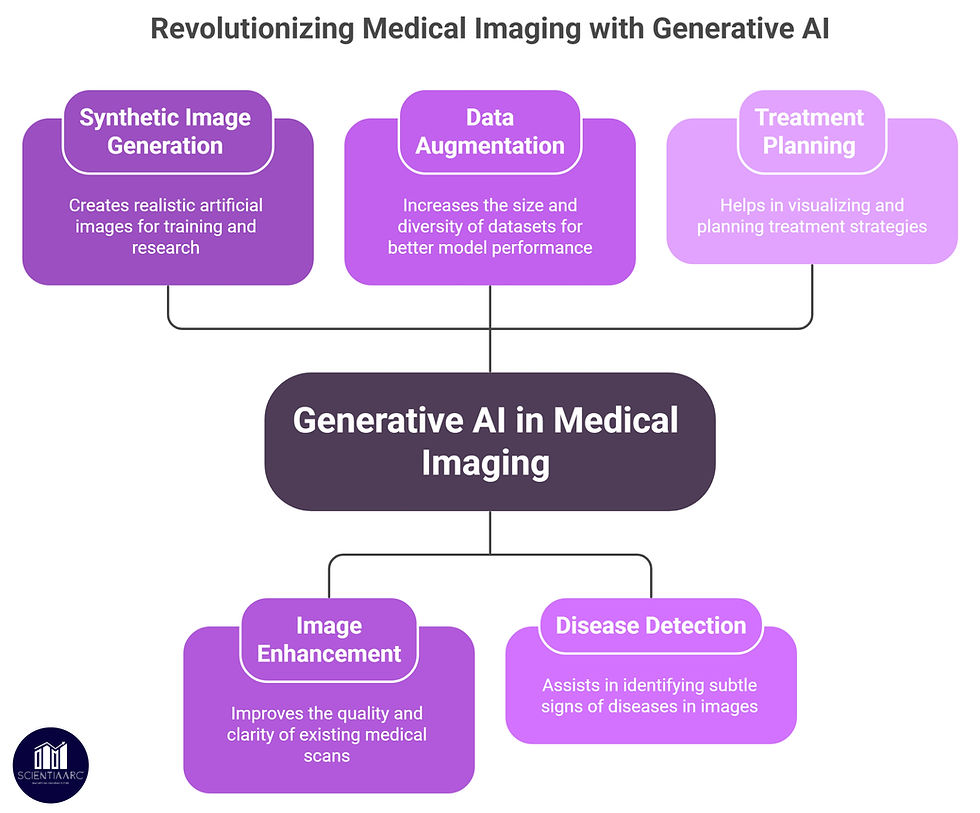
1. Image Synthesis
Generative AI can create synthetic medical images that closely resemble real patient data. This capability is particularly useful in scenarios where obtaining large datasets is challenging, such as rare diseases. By generating diverse training datasets, AI models can improve their performance and generalizability.
2. Image Enhancement
Generative models can enhance the quality of medical images by reducing noise, improving resolution, and correcting artifacts. Techniques like super-resolution can transform low-quality images into high-resolution counterparts, enabling better visualization of anatomical structures and pathological features.
3. Data Augmentation
In machine learning, data augmentation is essential for improving model robustness. Generative AI can augment existing datasets by creating variations of images, thereby increasing the diversity of training data. This is particularly beneficial in scenarios with limited labelled data, helping to prevent overfitting and improve model performance.
4. Disease Detection and Diagnosis
Generative AI can assist radiologists by highlighting potential areas of concern in medical images. By training models on annotated datasets, AI can learn to identify patterns associated with specific diseases, aiding in early detection and diagnosis. This capability can significantly reduce the workload of healthcare professionals and enhance diagnostic accuracy.
5. Personalized Treatment Planning
Generative AI can analyze medical images to create personalized treatment plans. By simulating different treatment scenarios and predicting outcomes based on patient-specific data, AI can assist clinicians in making informed decisions tailored to individual patient needs.

Benefits of Gen-AI in Medical Imaging
1. Improved Diagnostic Accuracy
The ability of Generative AI to analyze and interpret complex imaging data can lead to more accurate diagnoses. By reducing human error and providing additional insights, these technologies can enhance the overall quality of patient care.
2. Increased Efficiency
Generative AI can automate time-consuming tasks, such as image analysis and interpretation, allowing healthcare professionals to focus on more critical aspects of patient care. This increased efficiency can lead to faster diagnosis and treatment, ultimately improving patient outcomes.
3. Cost-Effectiveness
By reducing the need for extensive manual analysis and enabling the use of synthetic data for training, Generative AI can lower costs associated with medical imaging. This can make advanced imaging technologies more accessible to healthcare facilities, particularly in resource-limited settings.

Challenges and Considerations
1. Data Privacy and Security
The use of patient data for training AI models raises concerns about privacy and security. Ensuring that data is anonymized and protected is crucial to maintaining patient confidentiality and complying with regulations such as HIPAA.
2. Model Interpretability
Generative AI models, particularly deep learning approaches, can often act as "black boxes," making it challenging to understand their decision-making processes. Enhancing model interpretability is essential for gaining the trust of healthcare professionals and ensuring the safe deployment of these technologies.
3. Regulatory Approval
The integration of Generative AI into clinical practice requires regulatory approval to ensure safety and efficacy. Navigating the regulatory landscape can be complex, and developers must work closely with regulatory bodies to meet the necessary standards.
4. Ethical Considerations
The use of AI in healthcare raises ethical questions, particularly regarding bias in training data and the potential for unequal access to advanced technologies. Addressing these concerns is vital to ensure that Generative AI benefits all patients equitably.
Future Directions
The future of medical image processing with Generative AI is promising. Ongoing research is focused on improving the accuracy and efficiency of AI models, developing more robust algorithms, and exploring new applications in various medical fields. Collaborative efforts between technologists, clinicians, and regulatory bodies will be essential to navigate the challenges and maximize the benefits of these innovations.
Conclusion
Generative AI is revolutionizing medical image processing, offering innovative solutions that enhance diagnostic accuracy, improve efficiency, and personalize patient care. While challenges remain, the potential benefits of integrating these technologies into clinical practice are substantial. As research and development continue, the future of medical imaging holds great promise for improving healthcare outcomes and transforming patient experiences.
For more information, log on to https://www.scientiaarc.com/informationtechnology


Comments